Life in the Village and beyond, based around the interests of my life.

Life in the Village and beyond, based around the interests of my life. Sunset at Telegraph Point.

Monday, March 4, 2013

The Little Carport That Could

Turning A Carport Into A Multi Use Room

Years ago when we first bought our old cabin in the woods, we had all of our five teenage children at home, and not enough rooms to give them all some privacy.
The old home had a carport off the end of the house, where the car barely fitted because of what else was stored under there.


 At the other end from the family chariot, was some space that we used to store boxes (and other stuff) before they were unpacked, and a place found for the contents.


We had inherited another old shed - of sorts - that defied gravity and the best attempts of mother nature to bring it down.


So, after we had found a home for all the goods and chattels that occupied the carport, it was time to turn it into a live-able room.   I built this in my spare time, and was lucky to already have the roof in place.

Once the supporting framework of the stud walls was added, the steel posts that had supported the roof were removed.  They were re-used for a back verandah on the northern side of the house.  I built it later.


The two windows shown here were taken out, and became a double window along the short side of the room, while I sourced some other timber-frame windows for the long wall.
The first window space became a door between the rooms, and the second was covered completely when the interior was lined.

All the exterior log linings were re-used on the new exterior walls.


An access ramp was added a little later, and this was covered with a narrow verandah roof.

Being in a hurry to get the room ready for occupation, it was lined inside, but the ceiling - of tongue and groove boards - was never ever painted.
Until now.

Years of exposure outside had darkened and weathered the timber.  In our advancing years, with our eyesight not what it was, the LOML suggested that a coat of paint might not only brighten things up, but also help us to see better when we use this room.
Did I say - we - you all know what I mean though, don't you.


Because  of the immutable law that says that we will fill whatever space is available to us, and the fact that we are expecting family guests this weekend, the furniture etc has to stay in the room while I paint around it.

It is being done in two halves.
It doesn't look like it because of the wide angle lens used for the picture........ but.......
The far end (half the room) is finished, while the half nearest is 3/4 undercoated, with one panel left to do.
This is all brush work, and involves lots of looking up with a bent neck.
You can see what the original timber lining boards looked like before undercoating.
And the finished colour at the far end isn't too shabby.


Hope she's happy..................
................... I know I am.

Happy woodworking to all.

Friday, March 1, 2013

The Disston Number 9 Backsaw - A Lucky Find

My hometown is Brisbane, and we often travel there - as I have oceans of family in that lovely city.

On one of our recent trips, we were making good time, so we planned a late lunch and pulled off the highway into the little hamlet of Bangalow.
There is a particular park that has been a stopping spot for us for decades.
Well, on this occasion, the town was busy - no car parks anywhere - not even down by the old railway station.
We drove around and around before spotting a vacancy at the bottom of the hotel carpark.
For Patrons Only didn't worry us, as we were going inside to order drinks in any case.

Unknown to us all these years, was the fact that we had parked next to the back gate of HEATH'S OLD WARES & COLLECTABLES

After lunch the emporium begged us to go see.

heathsOldWaresCounter.jpg

Apart from having cornered the market in old wooden ladders, Heath had aisles full of wonders.

It was down this next aisle that I discovered a milk churn full of saws:

aisle1HeathsOldWaresBangalo.jpg

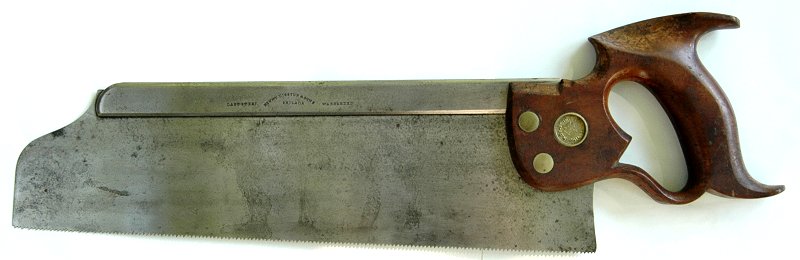
And among these saws there was this:


Needless to say, it didn't look this good at the time, and it has had a set and a sharpen since, but it was an unmistakable Disston Number 9 Backsaw.


The handle was complete, with no cracks or chips out of the spurs.


Even the brass saw nuts were in good shape.

The blade was straight and had only the slightest suggestion of rust dimpling.
This was a must have!
A quick check of my wallet showed that the moths had long ago vacated, and I was in the position of convincing my beloved of what an awesome buy this was, and could she go find an ATM while I guarded this piece of royalty of the sawmaker's art.


Long story short - it travelled with us to Brisbane, where I bored every one of my relatives who had not already been warned to avoid me, on what a miraculous find this had been, and how hard it was to find one of these in the wild.  Maybe they are common somewhere, but this is the first that I have seen in thirty years of sniffing out old tools.

There is a little more on Disston Backsaws HERE.

no9saw.jpg

I have now more backsaws than I regularly use and a cull is in order.
It has prompted me to consider for my next BLOG post a small presentation on Backsaws from the perspective of usefulness.
Stay tuned.

In the meantime I am one happy little vegemite.

Interestingly, Peter has responded to this post with an application for a patent by William J Reagan, issued on December 8 1874 for an Improvement in Handles for Saws, that contains the recess for the thumb.
The inventor thought that this same improvement could be added to other tool handles such as those on planes.
The link can be found here:

Patent number: 157634 Filing date: Nov 14, 1874 Issue date: Dec 8, 1874

Many thanks Peter.

NOTE: - All images used from other websites are acknowledged under each image.


Friday, February 22, 2013

Timbertown - An 1800's Experience


Our Hastings Woodworkers Guild Workshops and Clubrooms are situated in Timbertown - the historic 1800's theme village at Wauchope NSW.
 
While we are not busy with club projects or clubroom duties, it is a joy to wander the village and encounter the characters who enliven the day to day.


Bullocky

an extract
Beside his heavy-shouldered team 
thirsty with drought and chilled with rain, 
he weathered all the striding years 
till they ran widdershins in his brain: 


Till the long solitary tracks 

etched deeper with each lurching load 
were populous before his eyes, 
and fiends and angels used his road.


All the long straining journey grew 
a mad apocalyptic dream, 
and he old Moses, and the slaves 
his suffering and stubborn team. 

Then in his evening camp beneath 
the half-light pillars of the trees
he filled the steepled cone of night 
with shouted prayers and prophecies.

While past the campfire's crimson ring 
the star struck darkness cupped him round.
and centuries of cattle-bells 
rang with their sweet uneasy sound. 
From Judith Wright http://www.poemhunter.com/best-poems/judith-wright/bullocky-2/

The Village Blacksmith
an extract

Under a spreading chestnut tree
The village smithy stands;
The smith, a mighty man is he,
With large and sinewy hands;
And the muscles of his brawny arms
Are strong as iron bands.


His hair is crisp, and black, and long,
His face is like the tan;
His brow is wet with honest sweat,
He earns whate'er he can,
And looks the whole world in the face,
For he owes not any man.

Week in, week out, from morn till night,
You can hear his bellows blow;
You can hear him swing his heavy sledge,
With measured beat and slow,
Like a sexton ringing the village bell,
When the evening sun is low.

And children coming home from school
Look in at the open door;
They love to see the flaming forge,
And hear the bellows roar,
And catch the burning sparks that fly
Like chaff from a threshing-floor.


Toiling,--rejoicing,--sorrowing,
Onward through life he goes;
Each morning sees some task begin,
Each evening sees it close;
Something attempted, something done,
Has earned a night's repose.


Thanks, thanks to thee, my worthy friend,For the lesson thou hast taught!
Thus at the flaming forge of lifeOur fortunes must be wrought;
Thus on its sounding anvil shaped
Each burning deed and thought!
 From Henry Wadsworth Longfellow http://www.readbookonline.net/readOnLine/1218/


With special thanks to Craig the Bullocky and Doug the Smithy from Timbertown

Monday, February 4, 2013

A Value Far Beyond Pearls - Old World Chisels

Yep - Old Tools time again.
By now you will know that I have a relationship with old hand tools that permeates my woodwork.  And from time to time I wax lyrical about them.

Anyhoo, years and years back - can't remember when, it may be decades by now, I acquired one chisel among a few others, that I liked immediately, and have used ever since. It is a Mathieson bevelled edge with a lovely fine blade.

Ever since, I have kept looking for others - and every few years or more, another has come along.

On Sunday, I found another, and now have a grand total of four.
These are 1/8, 1/2, 5/8 and 1-1/4.
The handles are a joy to hold, and the steel is very good.

Alex Mathieson - Glasgow - made hand tools from 1822-1966.  Just when these particular four chisels were made is unknown to me, but I'd like to think that they are either late 19th or early 20th century tools.

The handles are beech, and brass ferrules guard against splitting - as these are tanged bevelled edge chisels.  They are excellent paring chisels, the shape of the handle aiding their dexterity.

Having shared my find with some friends, the subject of American chisels came along, specifically in relation to trying to identify trade marks stamped on the chisel face or socket.

This is the one that sparked the discussion, and next to it, what it would have looked like in its younger days:


Specifically: Union Hardware Co - Torrington Connecticut
It occurred to me to post some more of the American made chisel logos to assist in identifying troublesome and hazy trade marks in the future.
So - here they are.

Chisels Manufactured in the USA
Brand and Trademark

Of necessity, this will be a work in progress as I do not have access to all the possible trade marks and logos - there are hundreds.  It is but a start.


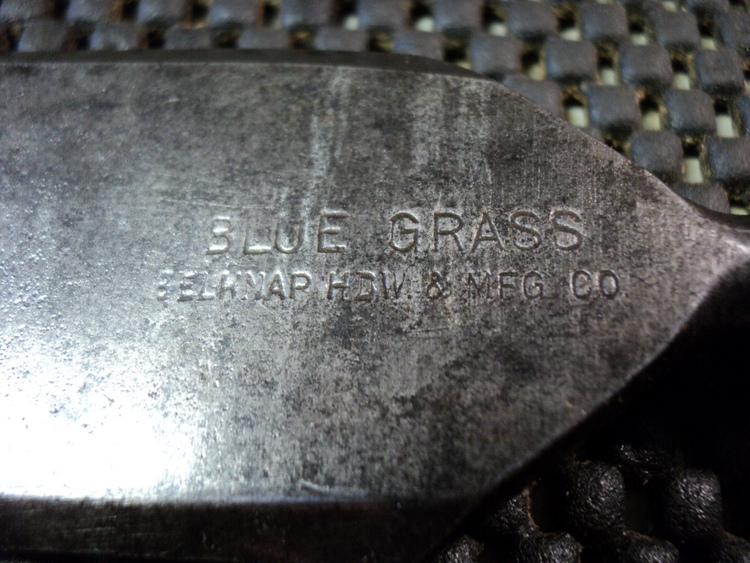
Blue Grass by The Belknap Hardware & Manufacturing Co


D R Barton - Rochester NY - One of the best


Douglass Manufacturing Co - Precursor to The James Swan Co - and as good as ...


Greenlee - Rockford Illinois


C E Jennings & Co


G I Mix & Co


And ........


Peck, Stowe & Wilcox - later to become:


Pexto - along with P S & W - one of the best


Sargent & Co NY


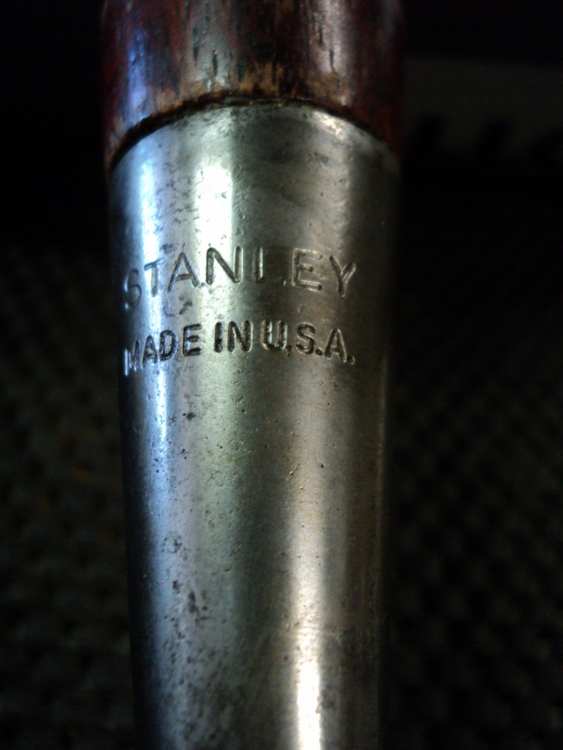
Stanley - of course!  Of which there were numerous trade marks.


The James Swan Co - successor to the Douglass - One of my top two US chisel makers of all time.


L & I J White

Image courtesy of Nicholas Bourke - Gratias my friend
Winsted Edge Tool Works - aka Thomas Witherby


T H Witherby - The other of my top two US chisel makers of all time.

Well this is a start - I'll add to these marks as they come to hand.  In the meantime here is a small reference for those seeking clarification of US Chisel Trade Marks & Logos.

If you have any different logos or trade marks that you don't mind sharing, you can:


....it would be very much appreciated.


Happy chiseling
SG

Friday, January 25, 2013

Happy Anniversary Day

We call it Australia Day now - but according to Wiki...............

In 1888, all colonial capitals except Adelaide celebrated 'Anniversary Day'. In 1910, South Australia adopted Australia Day,[10] followed by Victoria in 1931.[13] By 1935, all states of Australia were celebrating 26 January as Australia Day (although it was still known as Anniversary Day in New South Wales).[10]

Whatever we call it - it is our 4th of July, our Bastille Day, our national day to celebrate our one-ness as the nation of Australia.  So happy Australia Day to all!


http://api.ning.com/files/0f615wLw7mk-g2V8jipuCmhOglNhnaZVUMDrhgNkVezNdZhEmHEJUE62Iz-Twel0mSC64Ex5UO4SbyROZv0mg2SvymkeyBya/GW_Australia_Day_Flag_Map.jpg


Twelve months ago, I highlighted the debt that we owe to past Australian tool manufacturers and the heritage that they have left us. See Oz Day 2012 

I thought that this year I would focus on one of our current woodworking tool manufacturers, and look a little more closely at his contribution to our craft.

HNT Gordon - Planemaker

Terry Gordon has been making planes in his Alstonville NSW workshop since the early 1990's and commenced trading in 1995.

He has always set for himself the highest of standards, and outlines these in his business principles:


Any plane we  make will be able to plane or scrape any wood without tearout 
We will only use high quality materials with a simple appropriate design to offer customers affordable quality in tools that will make your woodwork better. 
We have done considerable development work to learn how to harvest, dry and stabilise Australian hardwoods (in particular gidgee) to give give us a superior quality wood for plane making that has ever been used before.  In conjunction with this we have learnt how to combine this wood with brass using modern glues to enhance the function and life of some wooden planes.   As a consequence of this work we offer an unconditional guarantee on workmanship and materials without hesitation.
I have been using Terry's planes for many years, and have a fondness for them when using Australian hardwoods especially.
They are well suited to controlling tearout in these timbers, and leave an excellent finish.

Here is an HNT Gordon Trying plane - which is superb on a shooting board and excellent for board jointing.  I prefer it on shorter boards, but on very long boards I still reach for my Stanley Number 8.


Terry makes a range of Block, Jack and Smoothing Planes.  I have found that his work is so exact, that these planes all present with very fine mouths and take the finest of shavings.  To me, this makes them different varieties of smoothing planes, but of differing lengths.


Here is The HNT Gordon A55 Smoothing plane, and traditional Smoothing Plane.  Both are excellent - with wonderful blades and tight mouths to produce the whispiest of gossamer shavings.


This is Terry's Aussie Jack Plane, and it too is beautifully built.  It, too, takes the whispiest of fine shavings, and leaves a smooth finish.  It is, in my eyes, another smoother.  I use jack planes for thick shavings from an open mouth - so that the timber is removed quickly.  My Australian-made Carter number 5 is a great example of this, and far more useful as a Jack plane to me.


It is Terry's Shoulder Planes that really shine.  Here, the precise construction and fine engineering again give consummate control in relieving the shoulders of tenons and truing their faces.


From left to right - 1/2 inch, 3/4 inch, 1 inch and 1-1/4 inches wide shoulder planes.  These are different examples of the same timber - Macassar Ebony.  Below, a side view.


The range of handplanes made by HNT Gordon is extensive, and these have been but a sampling.  All are works of the toolmaker's art and are a pleasure to use.  Here is a broader  illustration of part of the range available from the planemaker's own website:

http://www.hntgordon.com.au/africanblackwoodset.htm

And in Snakewood:


HNT Gordon also manufacture a variety of specialty planes suited to the cabinetmaker and to the master craftsman.


HNT Gordon Dado planes are a work of art, and contain an adjustable nicker that is as beautiful as it is effective


Add to these, hollows and rounds, snipe bill planes and side rebate planes, and the field is well covered.  Terry is also producing both male and female dovetail planes - coming soon.

The images above courtesy of HNT Gordon

So Happy Australia Day Terry, and on behalf of the woodworking community, thank you for what you have contributed to the world of woodworking, and to Australian woodworking in particular, where you are best known.

For the rest of us there is the singular pleasure of using HNT Gordon planes and other hand tools that enhance our chosen craft.

Happy Australia Day to all................