The various parts are sloooooowly coming together - a right shoulder injury is hampering my activities mightily at the moment. It is taaaking .... sooo ...... looong to get the smallest tasks completed.
Serendipitously, it gives me an even greater appreciation of the courage and abilities of the competing para-olympians. I really admire those athletes! Two weeks to go - bring it on!
OK, here are the bits.
Let's have a go at putting things together.
The body has had an embellishment added to the toe - in the form of the same burl veneer as the headboard. Two reasons for this - to tart it up a bit, and provide a little balance in the design - and the second reason is to cover a badly matched join where the two sides met.
By making it wedge shaped, the filler piece can be cut oversize, slid into place and glued - then the top and bottom trimmed off. Looks OK I think.
I'll be fitting the back first, so the back linings are attached.
Linings for the back are glued in place - hooray for clothes pegs!
Here are the back linings after drying.
I'll have to attach the neck before the top goes on, to give me room to clamp the neck tenon in place.
I'll fit and glue the back next, as the design of my neck means it has to be attached from the top, and
the fretboard over the top of the soundboard. Do these later.
I hoped to have more done than this, but ...... life intervenes .............
.... the shoulder, doc - the shoulder ...................owwwch!
Until next time ................
Love life and live ..........
Life in the Village and beyond, based around the interests of my life.
Life in the Village and beyond, based around the interests of my life. Sunset at Telegraph Point.
Saturday, August 18, 2012
Tuesday, August 7, 2012
Building a Ukulele - Part 6 - The Parts Come Together
Things have slowed down on the ukulele building front, while I have to attend to other matters, but I have found time to keep chipping away at it in little bits.
The neck needed some shaping around the heel, and after many attempts with different tools, I found an old fashioned sloyd type knife to be the best choice. I think I got this one with an AWR subscription years ago. It is a beauty.
This part of the heel is awkward for handtools, and the knife handles it easily. I will be using it even more now that I have realised how versatile it is.
Here is the shaped neck at the heel. Not your conventional tapered point, but will suit me for this - my first ukulele. It resembles the heels on cutaway ukuleles, and will provide more surface area for the glue -up of the neck to body.
Here are the parts prior to glue up of the end blocks and curved sides. End blocks are cedar, and I have pre-cut the slot in the heel block to take the tenon on the end of the neck.
The near finished back is also shown in this photo.
Here is the body glued up in the mould with end blocks in place. This shows the body as it is seen from the back.
Making the Soundboard
The soundboard is made from western red cedar, that has been ripped from planks from my brother in law's renovated kitchen. I was really lucky to score some old growth, tight grained timber that had been quarter-sawn. Look how tight those growth rings are on the timber below. Perfect.
Before I assemble the soundboard, it is important to lay it out, and mark the position of the sound hole. The sound hole patch has to be glued on to the back before the sound hole is cut, but it is a good idea to drill a small marker hole in the soundboard before gluing, so it can be found again for the cut. This is because the drawn circle will be covered by the sound hole patch, which is there to re-inforce the area around the sound hole.
Good old Millers Falls Buck Rogers 308 to the rescue.
After the re-inforcing patch is dry, it is time to cut the sound hole. I use the rosette cutter that I made previously, and I cut from both sides. Here I am cutting the front. The rosette cutter does a nice job. I am very happy with it.
OK, going to take a break for a few days now while glued things dry. Next task will be to brace and finish the soundboard, before adding the linings to the body. The linings will provide the surface area for the front and back to attach to the sides.
Not long to go .............
Can't wait.
Love life and live .......................
The neck needed some shaping around the heel, and after many attempts with different tools, I found an old fashioned sloyd type knife to be the best choice. I think I got this one with an AWR subscription years ago. It is a beauty.
This part of the heel is awkward for handtools, and the knife handles it easily. I will be using it even more now that I have realised how versatile it is.
Here is the shaped neck at the heel. Not your conventional tapered point, but will suit me for this - my first ukulele. It resembles the heels on cutaway ukuleles, and will provide more surface area for the glue -up of the neck to body.
Here are the parts prior to glue up of the end blocks and curved sides. End blocks are cedar, and I have pre-cut the slot in the heel block to take the tenon on the end of the neck.
The near finished back is also shown in this photo.
Here is the body glued up in the mould with end blocks in place. This shows the body as it is seen from the back.
Making the Soundboard
The soundboard is made from western red cedar, that has been ripped from planks from my brother in law's renovated kitchen. I was really lucky to score some old growth, tight grained timber that had been quarter-sawn. Look how tight those growth rings are on the timber below. Perfect.
Before I assemble the soundboard, it is important to lay it out, and mark the position of the sound hole. The sound hole patch has to be glued on to the back before the sound hole is cut, but it is a good idea to drill a small marker hole in the soundboard before gluing, so it can be found again for the cut. This is because the drawn circle will be covered by the sound hole patch, which is there to re-inforce the area around the sound hole.
Good old Millers Falls Buck Rogers 308 to the rescue.
After the re-inforcing patch is dry, it is time to cut the sound hole. I use the rosette cutter that I made previously, and I cut from both sides. Here I am cutting the front. The rosette cutter does a nice job. I am very happy with it.
OK, going to take a break for a few days now while glued things dry. Next task will be to brace and finish the soundboard, before adding the linings to the body. The linings will provide the surface area for the front and back to attach to the sides.
Not long to go .............
Can't wait.
Love life and live .......................
Wednesday, August 1, 2012
Building a Ukulele - Part 5A - Backs and Necks Continued
A few more steps before the back is finished. Firstly the bracing needs thinning down to reduce weight, and hopefully improve the sound.
I use a Stanley 102 block plane, which suits this task very well, as it has curved sides. A straight sided block plane would put undue pressure on the already curved back and may cause cracking. The little wood block is used as a side support for the brace while planing.
Lie Nielsen claim that the tiny violin plane was based on the Stanley 101, but I think that it more closely resembles the 102 - which is itself a small block plane. The 102 is one of the simplest of all planes with no adjuster, yet it works like a charm.
You can see the similarities here.
Once the bracing has been shaped to an appropriate profile, it is time to pare off the ends - to create a smoother interface with the sides, and to fit into the linings.
Traditionally, this has been done with a paring chisel, and the ends are scalloped in a rounded taper.
I used a long handled Japanese paring chisel as it gives more control in this situation.
The ukulele back is rounded from the application of the curved bracing, so the edges need some support while paring.
An offcut from the neck serves well here.
Here is the near finished back showing both sides.
It will sit on the body which is slowly taking shape.
I have bent one of the sides, and it is sitting in the mould, drying, while I work on the neck. The bending was a tortuously slow process of heating, bending a little, heating some more, bending a little more - and trying it on the curve of the mould - repeat over and over - ad infinitum.
It took me a full morning to form up that one side.
The Neck
Now to put the finishing touches to the neck. I was dreading this, thinking that I would either utterly destroy it, or end up with something resembling an Irishman's buckthorn shillelagh.
Happily, it went well, and I am pleased with the result.
After rough shaping with coarse and fine rasps, I started on coarse sandpaper - 80 grit in this case.
I then worked my way through four more grades of sandpaper - from coarse 120 grit up via 180 and 220 to finish on 320 grit.
There were still some parts that were a little rough and needed the attention of a scraper.
Here it is near finished.
While it doesn't resemble those immaculate CNC creations that grace commercial ukes, it isn't too shabby either.
I have glued a piece of eucalypt burl veneer - with a similar colour to rosewood - to the face side of the headstock. It should dry overnight.
I'll cut it to shape tomorrow after it dries.
All in all, not a bad day's work.
I am beginning to wonder why ukuleles don't cost around $1000 each, given what I am finding has to go into their construction.
Next step will be part two of the body - I am getting the bends just thinking about it ..........
Love life and live ..................
I use a Stanley 102 block plane, which suits this task very well, as it has curved sides. A straight sided block plane would put undue pressure on the already curved back and may cause cracking. The little wood block is used as a side support for the brace while planing.
Lie Nielsen claim that the tiny violin plane was based on the Stanley 101, but I think that it more closely resembles the 102 - which is itself a small block plane. The 102 is one of the simplest of all planes with no adjuster, yet it works like a charm.
You can see the similarities here.
Once the bracing has been shaped to an appropriate profile, it is time to pare off the ends - to create a smoother interface with the sides, and to fit into the linings.
Traditionally, this has been done with a paring chisel, and the ends are scalloped in a rounded taper.
I used a long handled Japanese paring chisel as it gives more control in this situation.
The ukulele back is rounded from the application of the curved bracing, so the edges need some support while paring.
An offcut from the neck serves well here.
Here is the near finished back showing both sides.
It will sit on the body which is slowly taking shape.
I have bent one of the sides, and it is sitting in the mould, drying, while I work on the neck. The bending was a tortuously slow process of heating, bending a little, heating some more, bending a little more - and trying it on the curve of the mould - repeat over and over - ad infinitum.
It took me a full morning to form up that one side.
The Neck
Now to put the finishing touches to the neck. I was dreading this, thinking that I would either utterly destroy it, or end up with something resembling an Irishman's buckthorn shillelagh.
Happily, it went well, and I am pleased with the result.
After rough shaping with coarse and fine rasps, I started on coarse sandpaper - 80 grit in this case.
I then worked my way through four more grades of sandpaper - from coarse 120 grit up via 180 and 220 to finish on 320 grit.
There were still some parts that were a little rough and needed the attention of a scraper.
Here it is near finished.
While it doesn't resemble those immaculate CNC creations that grace commercial ukes, it isn't too shabby either.
I have glued a piece of eucalypt burl veneer - with a similar colour to rosewood - to the face side of the headstock. It should dry overnight.
I'll cut it to shape tomorrow after it dries.
All in all, not a bad day's work.
I am beginning to wonder why ukuleles don't cost around $1000 each, given what I am finding has to go into their construction.
Next step will be part two of the body - I am getting the bends just thinking about it ..........
Love life and live ..................
Tuesday, July 31, 2012
Building a Ukulele - Part 5 - Backs and Necks
Yep, the rosette cutter is still over in Wauchope, so the soundboard still awaits. However, not to waste time, I did some work on the back and the neck today.
The back, like the sides, is made from sassafras. I cut these two bookmatched pieces from a board milled over at the Hastings Woodworkers Guild Clubrooms. It has a little character that pleases, and hopefully will have some nice tonal qualities in the finished ukulele.
I have made an MDF template for the tenor sized ukulele, and to create the little bit of overlap that I need, I use a washer with the pencil in the marking out - silky smooth.
There are some ragged parts around the edges of this sassafras, but that was in the board when I ripped it. Positioning the template carefully avoids these.
I will be careful to save the offcut at the top, as this has just enough width to be used as a centre strip, to re-inforce the glue join in the back.
Its grain is short and it will sit across the join at right angles to the run of the grain in the back. Waste not - want not.
It has the bonus of having the same tonal quality as the back, so may be an advantage in the sound department as well.
The bandsaw makes short work of cutting out the back.
There will be three braces across the back - one across the waist and one across each of the bouts (the widest part at the top and the widest part at the bottom) - upper and lower.
These are radiused on the 15 foot sanding block that I made earlier, and the curved sides are glued to the inside of the back, giving it a gentle curve.
I really should make a jig for this, but in the meantime here is the glue up with numerous clamps and their packing. The braces still need shaping, but I will do that when they are firmly glued and dry.
While the back dries, I started work on shaping the neck. It is waaaay oversize at the moment and shows all the rough cutting from the bandsaw.
The headstock needs smoothing, and this will be dressed up with a glued on piece of veneer after it is shaped. I am using this little Lie Nielsen block rebate plane, as it can plane right up to the tiny lip that seats the nut.
After some refining of the shape, it is time to start rounding the neck to a more gracious curve, that will be kind to the left hand that plays the fretboard.
I am using course and finer rasps at this stage, and have to be extra careful - as these can remove a lot of wood in a very short time.
Here is where the jig that I made, to hold the neck while shaping, comes into its own.
Things are coming along nicely. Once the neck is formed, it will be time to bend up the body and glue in the end blocks.
Can't wait ..................
The back, like the sides, is made from sassafras. I cut these two bookmatched pieces from a board milled over at the Hastings Woodworkers Guild Clubrooms. It has a little character that pleases, and hopefully will have some nice tonal qualities in the finished ukulele.
I have made an MDF template for the tenor sized ukulele, and to create the little bit of overlap that I need, I use a washer with the pencil in the marking out - silky smooth.
There are some ragged parts around the edges of this sassafras, but that was in the board when I ripped it. Positioning the template carefully avoids these.
I will be careful to save the offcut at the top, as this has just enough width to be used as a centre strip, to re-inforce the glue join in the back.
Its grain is short and it will sit across the join at right angles to the run of the grain in the back. Waste not - want not.
It has the bonus of having the same tonal quality as the back, so may be an advantage in the sound department as well.
The bandsaw makes short work of cutting out the back.
There will be three braces across the back - one across the waist and one across each of the bouts (the widest part at the top and the widest part at the bottom) - upper and lower.
These are radiused on the 15 foot sanding block that I made earlier, and the curved sides are glued to the inside of the back, giving it a gentle curve.
I really should make a jig for this, but in the meantime here is the glue up with numerous clamps and their packing. The braces still need shaping, but I will do that when they are firmly glued and dry.
While the back dries, I started work on shaping the neck. It is waaaay oversize at the moment and shows all the rough cutting from the bandsaw.
The headstock needs smoothing, and this will be dressed up with a glued on piece of veneer after it is shaped. I am using this little Lie Nielsen block rebate plane, as it can plane right up to the tiny lip that seats the nut.
After some refining of the shape, it is time to start rounding the neck to a more gracious curve, that will be kind to the left hand that plays the fretboard.
I am using course and finer rasps at this stage, and have to be extra careful - as these can remove a lot of wood in a very short time.
Here is where the jig that I made, to hold the neck while shaping, comes into its own.
Things are coming along nicely. Once the neck is formed, it will be time to bend up the body and glue in the end blocks.
Can't wait ..................
Wednesday, July 25, 2012
Building a Ukulele - Part 4 - Moulds and Jigs
These are a necessary part of any ukulele build and the time taken to prepare then is returned multi-fold down the track.
I have used an outline from the LOML's tenor ukulele body. That particular uke has such a sweet sound - let's hope this one is as good.
The body mould is made from laminated scraps of MDF and particleboard, while the interior retainers are simply radiata pine with cable tensioners used as expanders. The mould is made in two pieces so that the body can be removed when complete.
The neck brace is made up of some 4"X2" radiata pine scraps that will be held in the bench vice in use. It has a sliding headstock support, made from an offcut from this neck and some scraps that have been glued together.
A sliding bolt anchors this in any position to suit the length of the neck being worked on.
This ukulele neck is a tenor - a concert and soprano have shorter necks, and a baritone neck is longer.
This jig will support them all.
The back braces have to be formed on a radius of 15 feet, so a sanding block - cut to this profile - is necessary. A 15 feet length of string and a pencil are all that are needed to mark this out.
After marking it out and rough cutting, it needs smoothing. What better than a compass plane to finish this off. Here I am using a Record 020, which has a sole that can be adjusted to the required curve. Planing has to take place from the ends to the middle - to avoid tearout. This planes with the grain, and not against it.
I was hoping to have the soundboard made, but I took my newly made rosette cutter across to The Hastings Woodworkers Guild Clubroom on Saturday, and foolishly left it there.
So I have had to make myself busy on other aspects of the Uke build until I retrieve it. It's over an hour's drive, so I'm going to leave it there until next time I visit.
Tomorrow, I'll start cutting out the sides and the end blocks, as well as forming up the back braces and gluing up the the back.
The back and sides are sassafras, and the soundboard will be western red cedar.
Tomorrow will be busy.
Happy woodworking to all ................ and ........................
May your life sing ....................
I have used an outline from the LOML's tenor ukulele body. That particular uke has such a sweet sound - let's hope this one is as good.
The neck brace is made up of some 4"X2" radiata pine scraps that will be held in the bench vice in use. It has a sliding headstock support, made from an offcut from this neck and some scraps that have been glued together.
A sliding bolt anchors this in any position to suit the length of the neck being worked on.
This ukulele neck is a tenor - a concert and soprano have shorter necks, and a baritone neck is longer.
This jig will support them all.
The back braces have to be formed on a radius of 15 feet, so a sanding block - cut to this profile - is necessary. A 15 feet length of string and a pencil are all that are needed to mark this out.
After marking it out and rough cutting, it needs smoothing. What better than a compass plane to finish this off. Here I am using a Record 020, which has a sole that can be adjusted to the required curve. Planing has to take place from the ends to the middle - to avoid tearout. This planes with the grain, and not against it.
I was hoping to have the soundboard made, but I took my newly made rosette cutter across to The Hastings Woodworkers Guild Clubroom on Saturday, and foolishly left it there.
So I have had to make myself busy on other aspects of the Uke build until I retrieve it. It's over an hour's drive, so I'm going to leave it there until next time I visit.
Tomorrow, I'll start cutting out the sides and the end blocks, as well as forming up the back braces and gluing up the the back.
The back and sides are sassafras, and the soundboard will be western red cedar.
Tomorrow will be busy.
Happy woodworking to all ................ and ........................
May your life sing ....................
Tuesday, July 17, 2012
A Commission - Ukulele Interruptus
Been away ....................... back again - and itching to get on with the tenor ukulele build.
However ......................
.............a project for a client has interrupted the music of uke building for the moment.
Re-shaping the World -
A Desktop Globe With A Wooden Frame
Here it is - (well it is very similar, I have dismantled the one I'm working on) - a desktop earth globe, whose metal and plastic frame is to be replaced by one made from Australian rosewood. This has exercised my creative cortex for a while now, and I have finally come up with a solution that is both simple and practical.
The main part of this construction is the equatorial ring that supports the globe, and is in turn supported by the legs. Rough cutting the internal circle left some spokeshave work to do, to get it smooth.
I love rosewood, it is so easy to work, and soooo forgiving. Planing around the flat edges of this circle meant that there would be many times when I was planing against the grain - and across it. I started with my Millers Falls number 6, but soon had to reach for a smaller plane. Those shavings in the background are all from that process - gorgeous!
A small low angle block plane handled this easily. This is the little Lie Nielsen violin makers plane that I bought for the ukulele build, and it is perfect here.
For the lower circle that will brace the legs, I had to rip down to thickness from a suitably sized block of rosewood. It could have been planed to thickness, but I wanted to keep the scrap ripping for ukulele parts. In planing, all that is produced is shavings, where - by ripping - I can salvage some timber for later use.
Here, the Millers Falls squares the edge before I start on the table saw.
After running each edge over the tablesaw blade, I finished off with my Tyzack Nonpariel 6 point ripsaw. Ripping to thickness by hand is not one of my favourite pastimes, but this saw really sings - and it is as close to a pleasure as ripping can get when I use it. A truly beautiful saw is this one.
It might be Nonpariel, but it did a good job of cutting parallel in this case - heh, heh! (my kids hate my jokes!)
As you can see, I marked the circle on the wrong face (or I ripped the wrong face - take your pick) - easy fixed though.
The lower, smaller ring gets the same treatment as the upper ring, and there is plenty of work using the round bottomed spokeshave. This is the Veritas model, but there are plenty of others equally as good. Because the shave must go with the grain, and the grain changes so often in a circle, the workpiece had to be re-positioned in the vice many times over the course of this smoothing.
The legs are my own design, and are meant to complement the curves found everywhere else on this globe stand. They will stand wider than the original model for added stability.
Trial fitting before glue-up. Trusty 4 inch Silex square to the rescue.
The legs are fitted to the top ring with dowels and secured to the bottom ring with brass screws. No these aren't brass - I'm still waiting for them to arrive.
Glue-up time. Glue-up takes place with everything in position so that there are no regrets when it dries. The lower ring (top one in this view) can still be removed after the glue dries, but provides the tension and the bracing for the legs at the moment.
A coat or two of finish - and we're done.
Now - let's have a crack at the soundboard for that tenor ukulele ..................
Bring it on .................!
However ......................
.............a project for a client has interrupted the music of uke building for the moment.
Re-shaping the World -
A Desktop Globe With A Wooden Frame
Here it is - (well it is very similar, I have dismantled the one I'm working on) - a desktop earth globe, whose metal and plastic frame is to be replaced by one made from Australian rosewood. This has exercised my creative cortex for a while now, and I have finally come up with a solution that is both simple and practical.
The main part of this construction is the equatorial ring that supports the globe, and is in turn supported by the legs. Rough cutting the internal circle left some spokeshave work to do, to get it smooth.
I love rosewood, it is so easy to work, and soooo forgiving. Planing around the flat edges of this circle meant that there would be many times when I was planing against the grain - and across it. I started with my Millers Falls number 6, but soon had to reach for a smaller plane. Those shavings in the background are all from that process - gorgeous!
A small low angle block plane handled this easily. This is the little Lie Nielsen violin makers plane that I bought for the ukulele build, and it is perfect here.
For the lower circle that will brace the legs, I had to rip down to thickness from a suitably sized block of rosewood. It could have been planed to thickness, but I wanted to keep the scrap ripping for ukulele parts. In planing, all that is produced is shavings, where - by ripping - I can salvage some timber for later use.
Here, the Millers Falls squares the edge before I start on the table saw.
After running each edge over the tablesaw blade, I finished off with my Tyzack Nonpariel 6 point ripsaw. Ripping to thickness by hand is not one of my favourite pastimes, but this saw really sings - and it is as close to a pleasure as ripping can get when I use it. A truly beautiful saw is this one.
It might be Nonpariel, but it did a good job of cutting parallel in this case - heh, heh! (my kids hate my jokes!)
As you can see, I marked the circle on the wrong face (or I ripped the wrong face - take your pick) - easy fixed though.
The lower, smaller ring gets the same treatment as the upper ring, and there is plenty of work using the round bottomed spokeshave. This is the Veritas model, but there are plenty of others equally as good. Because the shave must go with the grain, and the grain changes so often in a circle, the workpiece had to be re-positioned in the vice many times over the course of this smoothing.
The legs are my own design, and are meant to complement the curves found everywhere else on this globe stand. They will stand wider than the original model for added stability.
Trial fitting before glue-up. Trusty 4 inch Silex square to the rescue.
The legs are fitted to the top ring with dowels and secured to the bottom ring with brass screws. No these aren't brass - I'm still waiting for them to arrive.
Glue-up time. Glue-up takes place with everything in position so that there are no regrets when it dries. The lower ring (top one in this view) can still be removed after the glue dries, but provides the tension and the bracing for the legs at the moment.
A coat or two of finish - and we're done.
Now - let's have a crack at the soundboard for that tenor ukulele ..................
Bring it on .................!
Thursday, July 5, 2012
Building a Ukulele - Part 3 - Making A Rosette Cutter For Soundboards
I don't have one, I need one, I have no idea where to buy one - so I'll make one.
After the soundboard is assembled, and before I fit it to the body, I will have to cut the inlay for the rosette, as well as the sound hole itself. So I need a circle cutter.
I found a couple of scraps of jarrah which will serve nicely, as well as a sliver of tool steel that has been kicking around the bottom of my tool box for decades. I can't remember where this originally came from, but it will make an ideal knife.
Other blade materials could be an old jigsaw blade, or a piece of hack saw blade or bandsaw blade - ground to shape.
I ground a skew before establishing a bevel, then sharpened on my oilstone and honed on white arkansas.
My first step was to cut a piece from the side of the scrap - the same width as the knife blade. This will be used for the wedge to hold the blade in place, as well as the sides of the body.
The knife will be positioned towards the end of an arm that slides within the body, and is held in place by a second wedge. More on this later.
I start with the housing for the blade and its wedge, and make sure that this is finished before shaping the arm that carries it. This is important, as it gives a solid block to work with while cutting the housing.
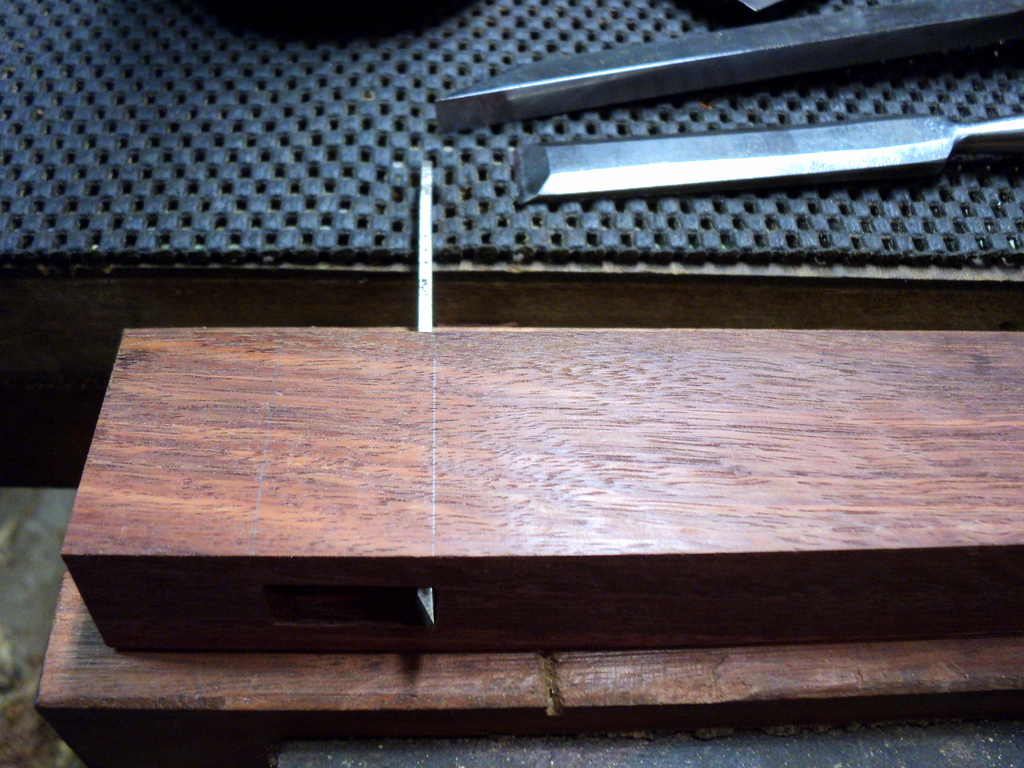
The housing is cut just like a through mortise. After marking it out, I drill out some of the waste - from both sides toward the middle (to stop tearout at the bottom), which would happen if drilled all the way through from the one side.
The knife side is that end of the housing closest to the body, so this has to be vertical. The outside end of the mortice is sloped to take the wedge. Don't reverse these, as this puts the knife too far away from the centre point, and limits the size of the minimum circle that can be cut.
I use a Narex morticing chisel and one of my bench chisels to clean up the inside walls. The Narex is made in the Czech Republic, and while cheap to buy, is well up to the task of handling this hard old jarrah. The bench chisel is a Pexto - nee Peck, Stowe and Wilcox - one of the best from the golden age of US tool manufacturing, and up there with Swan and Witherby.
Once the housing is finished, the sliding arm can be shaped. I keep the offcuts to be used in the body and the wedge, as they are exactly the same width as the sliding arm. Two pieces from the first ripping and the offcuts make up the body - glued and screwed.
Here are the assembled parts before gluing into place. The shape will be refined after the glue dries.
Cut the wedge for the knife, and glue and clamp.
Insert the centre pin, (a broken drill bit) and - voila - all done!
So ............... how does it cut ................?
Not too shabby at all .....................
Love life and live .......................
After the soundboard is assembled, and before I fit it to the body, I will have to cut the inlay for the rosette, as well as the sound hole itself. So I need a circle cutter.
I found a couple of scraps of jarrah which will serve nicely, as well as a sliver of tool steel that has been kicking around the bottom of my tool box for decades. I can't remember where this originally came from, but it will make an ideal knife.
Other blade materials could be an old jigsaw blade, or a piece of hack saw blade or bandsaw blade - ground to shape.
I ground a skew before establishing a bevel, then sharpened on my oilstone and honed on white arkansas.
My first step was to cut a piece from the side of the scrap - the same width as the knife blade. This will be used for the wedge to hold the blade in place, as well as the sides of the body.
The knife will be positioned towards the end of an arm that slides within the body, and is held in place by a second wedge. More on this later.
I start with the housing for the blade and its wedge, and make sure that this is finished before shaping the arm that carries it. This is important, as it gives a solid block to work with while cutting the housing.
The housing is cut just like a through mortise. After marking it out, I drill out some of the waste - from both sides toward the middle (to stop tearout at the bottom), which would happen if drilled all the way through from the one side.
The knife side is that end of the housing closest to the body, so this has to be vertical. The outside end of the mortice is sloped to take the wedge. Don't reverse these, as this puts the knife too far away from the centre point, and limits the size of the minimum circle that can be cut.
I use a Narex morticing chisel and one of my bench chisels to clean up the inside walls. The Narex is made in the Czech Republic, and while cheap to buy, is well up to the task of handling this hard old jarrah. The bench chisel is a Pexto - nee Peck, Stowe and Wilcox - one of the best from the golden age of US tool manufacturing, and up there with Swan and Witherby.
Once the housing is finished, the sliding arm can be shaped. I keep the offcuts to be used in the body and the wedge, as they are exactly the same width as the sliding arm. Two pieces from the first ripping and the offcuts make up the body - glued and screwed.
Here are the assembled parts before gluing into place. The shape will be refined after the glue dries.
Cut the wedge for the knife, and glue and clamp.
Insert the centre pin, (a broken drill bit) and - voila - all done!
So ............... how does it cut ................?
Not too shabby at all .....................
Love life and live .......................
Subscribe to:
Posts (Atom)